Girlpower Marketing
A communications, influencer & brand experiences agency
  • About
  • Blog
  • Approach
  • Services
    • Social Media & Digital Marketing
    • Content Marketing & Creation
    • Influencer Engagement
    • Brand Positioning
    • Traditional & Digital Media
    • Events & Brand Experiences
    • Creative Design
    • Research & Insights
    • Marketing to Women
  • Work
    • Case Studies
  • Insights
    • Blog
    • In the News
    • The Purchasing Power of Women
    • White Paper
  • Pick My Brain
  • Contact

Why Teens Terrorize Us

Excerpted from an essay by Lisa Heffernan on Grown and Flown.

I have a teen in my house who is leaving in a few short weeks. Despite the fact that I know that it is only a matter of days until I will bemoan his departure, I am still surprisingly adept at flying into a rage at him. His need to assert his newly adult self and my need to control what happens in my home are too often on a collision course. Despite our deep and abiding love for them, teens continue to terrorize us, creating the type of stress that scientists have now begun to measure.

Teenage Boy at Lake

One day your young person borrows your car, drives to a summer job and spends the day as an income-earning citizen fully capable of responsible employment. That very afternoon, your kitchen is trashed, there are dirty clothes carpeting the floor, and a well-established curfew has been dispensed with like it wasn’t even there. Your authority has been trampled. Your gas tank and refrigerator are empty, every inch of your car teems with discarded Gatorade bottles, beef jerky wrappers and trash that is simply beyond identification.

You remind yourself that this is what teens are like, alternately capable young adults and selfish self-involved children. You recall that it is the age, that they do not stay like this. If there are older children you throw your mind back to their transformation and then you turn around, willing yourself to be calm, and shriek, “WTF, that is the last time you borrow my car.”

I am alternately trying to figure out how to say goodbye to a child I love beyond reason and so apoplectic I cannot even speak to him. The seesaw that is raising a teen is a source of much stress. Some of it is undoubtedly my fault (or any parent’s fault) as we lurch around and grapple for steady ground as our children travel the rocky road to adulthood.

Teens terrorize us because:

  • They are neither one thing nor another. They are capable of being sane mature adults and petulant children, in the very same conversation. They have the bodies of grown ups and the emotional range of toddlers. They are risk seeking missiles whose favorite phrase is “I got this” when it is patently clear that they’ve got nothing. Our protective urge is undiminished but our ability to assure their safety is vastly reduced. This alone can result in sky-high stress.
  • They routinely overestimate their competence in dealing with adult matters. Even in the face of bad outcomes teens can struggle to see either their fault or how they could have done things differently. As parents with a lifetime of experience, this is painful to watch.
  • They inhabit a world of very real consequences. Their missteps can have profound effects on their future (and on others) yet they struggle to understand the gravity of their attitudes and actions.
  • They live on an emotional rollercoaster and as Lisa Belkin pointed out, they want us to ride it with them. She so aptly explains that we do not need to climb aboard with them (although it takes parents a while to learn this) but this still means that there is a fairground ride operating in our homes.
  • It all happens so quickly and we can barely catch our breath. At age 14 only 13% of teens had used alcohol in the previous month by age 18 that number is 41%. Similarly before age 15, 16% of teens have had sex and four years later that number is 71%. By the time the leave for college 54% of kids have been sexting. Much is changing in their lives, experiences and perspectives and as parents we can struggle to keep up.
  • It is just hard dealing with anyone, at any age, who already knows everything. This impenetrable fortress of knowledge is just one more battle ground in the fight between experience and the hubris of youth.
  • Adolescents confuse understanding with agreement.They think saying so, makes it so, according to Sheras, “They think if they explain something to you adequately, you will agree with them. So when parents say, ‘I’m not going to let you do that,’ adolescents almost universally say, ‘You don’t understand.’”
  • The influence of their peers outweighs ours. It is excruciating when you child values the insight of a peer (a mere child) whom he may have known for weeks or days, over the person who loves him the most and has his interest at heart (and BTW is an adult). It is hard not to wonder where their critical thinking has gone.
  • The balance has shifted. When our kids were small and we were unhappy with them or disciplined them, they got angry or contrite but they were not indifferent. If, in doing our jobs as parents of teens we make them unhappy, they may now withdraw. Punishing our kids always felt bad, but the silent treatment or their physical retreat makes it even worse.

I have long subscribed the U shape theory of parenting which suggests that the most challenging days are at the beginning and the end and that the sweet spot of parenting lies in the middle. I once told my brother that I would do a deal with the devil if my then 6, 9 and 10 year olds could stay little forever. The devil wasn’t buying and my kids became teens.


So Long Soccer Mom? Carmakers Fine-Tune Their Marketing Pitch to Women

Car Marketers Focus on Women

With women influencing up to 85% of all car purchases and outnumbering men in holding drivers licenses, automakers are beginning to make them a focus in their marketing efforts. We’re happy to be included in the Automotive News article below.

Fine-Tuning the Pitch to Women

Spots slowly shift from soccer moms to empowered professionals.

7 Major Mistakes When Marketing Cars to Women

Marketing Cars to Women

Looking to Market Cars to Women? Take This to Heart

Hockey legend Wayne Gretzky is a great example of a leader and game changer. He said it best when he explained the key to his success, “a good hockey player knows where the puck is – but a great hockey player knows where the puck is going.” True for a hockey player, but it makes sense even for the auto industry.

Today’s auto industry continues to be an industry owned and operated by men. Some 95% of the country’s 20,000 auto dealers belonging to the National Automobile Dealers Association are male, and for the most part, it shows. A staggering 75% of women say they feel car marketers just don’t understand them.

7 Marketing to Women Mistakes Being Made in the Auto Sales Industry Today

  1. Making Cars with Men in Mind.
    Female drivers now outnumber male drivers, according to the number of active drivers’ licenses. Still, many car manufacturers continue to craft vehicles with a man’s larger body in mind. Consequently, women are 47% more likely to suffer serious car injuries than men.
  2. Ignoring Safety in Favor of Style.
    Marketers insist on presenting cars to women that are sleek and stylish. Isaac Mizrahi even created a new line of clothing inspired by the 2013 Chevy Malibu, reminiscent of the horribly sexist faux pas Ford committed back in the 60s with their matching coats and bags. In reality, women are more concerned with a car’s safety features, along with seating space, power, fuel economy and style. Instead of creating skinny jeans that match her car upholstery, marketers would be well served to show a woman the technology that will keep her family safe.
  3. Assuming Men Handle the Repairs.
    Whether they’re handling the maintenance and repair requests for their own car or for the family car, it’s a fact that women schedule the appointments and deal with the technicians. Women make 65% of requests for service, and spend over $200 billion on new cars and maintenance each year.
  4. Passing Up the Trucks.
    Sure, women like the idea of sports cars just about as much as men. The fact remains that tiny, zippy cars aren’t always the wise choice. Steering women toward impractical vehicles won’t get a salesperson anywhere. Women know what they want, and a truck just might be her choice. In fact, women purchase 45% of all light trucks and SUVs.
  5. Pushing Electric Cars.
    The fact remains that electric cars still aren’t what women want.  In California – probably the most green-car-friendly state – women account for only 29 percent of Nissan LEAF, 24 percent of Chevrolet Volt, and 16 percent of Tesla Model S purchases and leases. Women simply don’t trust the power sources yet, and won’t purchase a vehicle that could possibly leave them, and perhaps their children, stranded.
  6. Asking A Woman What Her Husband Thinks.
    One of the biggest mistakes a car marketer might make is to focus on the male part of the equation. This hearkens back to the times when men made the bulk of a family’s financial decisions. Today, 43% of Americans with more than half a million dollars in assets are female, and over 30% out-earn their husbands. In addition, more and more heads-of-households are single moms. Don’t make the mistake of alienating a key customer by buying into outdated stereotypes.
  7. Understanding Your Market.
    Sales professionals get one shot to make the perfect first impression, because two-thirds of women who leave a dealership without buying will not return. So know your audience! Women like to tell stories. They don’t talk in bullet points. They want to tell their story, but are typically interrupted and cut off, leaving them feeling embarrassed and disrespected. When a man doesn’t understand that to relate to a woman means he needs to listen — that’s perhaps the biggest mistake of all.

What changes would you make to current car marketing campaigns? I’d love to know which ads strike a chord and which fall flat, so leave a comment!

5 Tips For Marketing Healthcare to Moms

Marketing Healthcare to Moms

How to Market Healthcare to Moms

Some 80 percent of Moms are the primary decision-makers when it comes to the health of their families, yet 66 percent feel misunderstood by healthcare marketers. To close that gap, here are five tips to consider when developing plans for marketing healthcare services to Moms.

Healthcare Marketing Tip #1: Don’t equate pink with female-friendly marketing.

Here’s a sign of how times have changed: Smithsonian.com reports that in the early 20th century, pink was actually considered the stronger color and more appropriate for boys, while blue was better-suited for girls. (“Today’s color dictate,” writes Jeanne Maglaty, “wasn’t established until the 1940s, as a result of Americans’ preferences as interpreted by manufacturers and retailers.”)

So while pink may now be a common shortcut to representing femininity, that wasn’t always the case. In fact, the association is currently having a negative effect, according to one study that observed negative reactions toward the use of pink in breast cancer awareness advertising. Why? Because pink emphasizes that breast cancer is a risk for women alone, and the connection between the color and gender provides a higher likelihood that women will go into denial about the possible dangers to their health.

To avoid your audience having the same reaction, go easy on the pink.

Healthcare Marketing Tip #2: Think outside the traditional family.

ABC’s sitcom Modern Family features an unusual family dynamic, with an older man married to a much younger woman — both of whom have children from previous marriages. The man’s daughter is married with three kids, and his gay son lives with his partner raising their adopted daughter. But some viewers have taken issue with the show’s title. In spite of the family’s unusual makeup, they argue that the three families are actually quite traditional, since each comprises a two-parent household, with one parent staying at home while the other works.

These critics may have a point. According to Jamie Dunham, 41% of all births today are to unwed mothers. Nuclear families with two parents may have been common in the 1950s, but that is not the case today. Be sure your marketing images reflect the times by avoiding overuse of the traditional family.

Healthcare Marketing Tip #3: Ask about their challenges.

Nothing beats going straight to the source for ideas and feedback, and one of the best ways to know what your customers want is to simply ask.

Create a survey for patients to fill out. Ask them what their biggest challenges are. Ask them what they like about your product or service, and what they’d like to see done differently. Keep track of the questions your patients ask and answer those in-depth.

Healthcare Marketing Tip #4: Be active on social media.

Women are extremely active on social media. This has important implications for healthcare marketers, because it means those sites are becoming crucial sources of information for Moms — for everything from the latest research on vaccinations to how to treat the stomach flu. And remember that patients are also searching for videos to answer their specific questions.

Work this trend to your advantage by being active on Facebook and other social channels, including YouTube, providing healthcare tips and information about your services.

Healthcare Marketing Tip #5: Be a source of information for Moms.

Besides being a resource on social media, be sure to provide information on your website through your blog and other forms of content. Think about your patients and what most concerns them. What are the top 10 patient conditions that you typically treat? What are some medical myths that you’d like to debunk? What are the common safeguards during flu and allergy seasons?

Gain Moms’ trust by making information easily accessible. Promote your content through social media channels. In addition to blogging, consider creating an email newsletter – 84 percent of Moms report sharing health-related information via email. And remember that Moms are true believers in word-of-mouth – when they find valuable information they feel compelled to pass it along to friends and family.

Today’s Mom is a social-media savvy consumer who gets her information in a variety of ways. She may or may not be married, and marketing messages that target yesterday’s women in stereotypical ways may leave her rolling her eyes.

The Buying Power of Women: Mars and Venus

Buying Power of Women

Women’s Buying Power Baffles Men

Interesting article in The New York Times about the very different approach to investing by men and women, aptly titled Mars, Venus and the Handling of Money. At the core of the article? As The Times puts it, “the data-driven approach of traditional firms is alienating many women. And the way that women prefer to deal with money — holistically, emotionally — can be baffling to the guys on Wall Street.”

They go on to say, “scores of recent studies show that we’re in the midst of a tectonic gender shift around money: It’s big, slow-moving and ultimately a game-changer. Women have money now, real money: They earn a combined $29 trillion worldwide, according to the Boston Consulting Group, about $3 trillion of that in the United States. And while men still earn more, women control nearly three-quarters of all purchasing decisions. Judging by other economic indicators, those numbers will only grow.”

We couldn’t agree more. For the complete article, go here.

This story first appeared in the Carlisle Financial Group blog (a Girlpower Marketing client).

Marketing to Women: Why Content Marketing Is A Great Strategy

Content Marketing and Women

Market to Women through Content Marketing

You’ve heard about it. Content Marketing. By its simplest definition, Content Marketing is the creation and sharing of different types of media designed to create a relationship with your customers and build loyalty for your brand. What could be more perfect for reaching women?

Women, like any other consumers, want information about the products and services that we’re spending our hard-earned cash on. But we’ve pretty much turned a blind eye to traditional marketing — fast forwarding through TV commercials, ignoring magazine ads, and hitting the “X” on banner ads. Great content, whether it is a blog post, infographic or video is perfect for giving us the information we need when making purchasing decisions.  We can comment on it, and share it.  However, when creating great content that is designed to resonate with women, marketers need to remember a few rules:

Avoid Stereotypes when Marketing to Women

Using old stereotypes and clichés is one of the quickest ways to turn off a female audience.

Content Marketing: One Size Doesn’t Fit All

All women are not the same, and they don’t respond to the same messages. Understand generational and lifestage differences and structure brand messages accordingly.

Build Relationships with Women with Content Marketing

Look for ways to help female consumers not only build relationships with your brand, but with each other.

Don’t Overtly Target Women when Marketing to Them

Don’t try so hard; we’ll see right through it. A subtle, more nuanced approach is more effective.

Remember the Emotional Connection

Emotions play an important role in a woman’s purchasing decisions and brand loyalty. We don’t always buy a product or service because it’s the best value for our money; many times our choice is driven by an emotional connection.

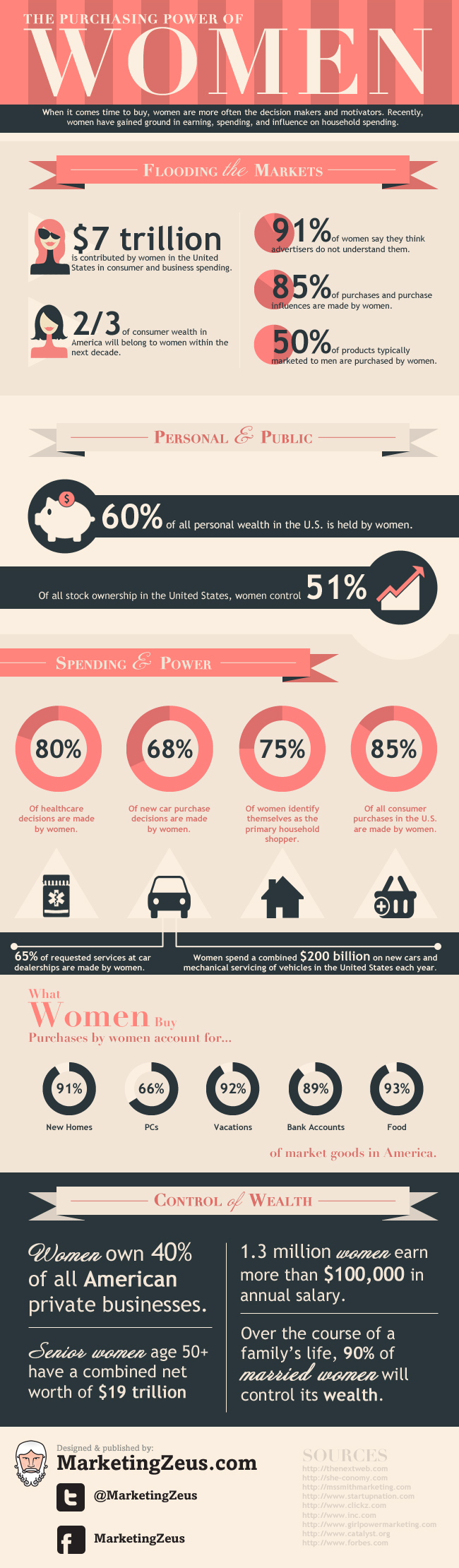
The Purchasing Power of Women

An infographic by Marketing Zeus shows the power of the female consumer.  Sources include Girlpower Marketing.

Purchasing Power of Women

Storytelling When Marketing to Women

Using Stories to Market to Women

How Women Think

Anyone who has been reading this blog knows that women think differently than men.  We’ve talked about how a woman’s brain has four times as many connections between the left and right hemispheres of the brain as a man’s. All of those signals hurtle down the superhighway into her right brain – the home of emotional memory, intuition and experience. A woman’s heart is in her brain – tell her a story that is filled with emotion, and explain why your brand is relevant to her.

Marketing to Women by Storytelling

Storytelling is the marketing buzzword of the moment.  Storytelling certainly isn’t a new concept – in the world of PR it has been a critical part of everything we do since the beginning of time. But with the onset of content marketing, the concept of storytelling as part of a strategy for marketing to women has become of increasing importance.

Stories help women consumers decide if they like, trust, and want to do business with a brand. Stories set the stage to begin a relationship that can last for years to come. Every brand needs a story to be a competitor in today’s marketplace, largely because social media has provided a forum for consumers to have conversations with brands, and stories set the stage for those conversations.

The reality is that consumers, especially women, are not drawn to a particular brand or its marketing goals.  They’re drawn to good stories. Stories that entertain, enlighten and inform. Regardless of whether those stories make a female consumer feel happy or sad, they do make her think and feel.  And the brands that know how to tell a good story will increasingly have her attention.

Today’s Women Finally Portrayed Realistically

Women Portrayed Realistically in Stock Photos

Women in Stock Photography

Kudos to LeanIn.org and Getty Images for coming together to offer a special collection of images that represent women and families in more realistic ways than the traditional stock photos of a businesswoman in a suit with glasses, or a mother pouring milk into their child’s cereal bowl.

There is an appetite for the images: The three most-searched terms in Getty’s image database are “women,” “business” and “family.” As Getty subscribers search images they will now see these new images alongside the usual ones, or they can specifically search Getty’s Lean In collection.

Kenyan Woman Challenging Change Is One of 2013 CNN Heroes

Kakenya Ntaiya is one of the top 10 CNN Heroes of 2013. You can vote for her, or any of the other top 10 Heroes, to be CNN Hero of the Year. That person will receive $250,000 to continue their extraordinary work.

Enoosaen, Kenya (CNN) — When she was 14 years old, Kakenya Ntaiya entered the cow pen behind her home with an elderly woman carrying a rusty knife. As a crowd from her Maasai village looked on, Ntaiya sat down, lifted her skirt and opened her legs. The woman grabbed Ntaiya’s most intimate body parts and, in just moments, cut them out.

“It (was) really painful. I fainted,” recalled Ntaiya, now 34. “You’re not supposed to cry.” For generations, this ceremony was a rite of passage for every Maasai girl, some as young as 10; soon afterward, they would marry and drop out of school.

About 140 million girls and women worldwide have been affected by female genital mutilation, also known as female circumcision. The procedure is commonly based on religious and cultural beliefs, including efforts to prevent premarital sex and marital infidelity.

While female circumcision and child marriage are now illegal in Kenya — new laws banning genital mutilation have contributed to a decline in the practice — officials acknowledge that they still go on, especially in rural tribal areas. Despite free primary education being mandated 10 years ago by the Kenyan government, educating girls is still not a priority for the Maasai culture. According to the Kenyan government, only 11% of Maasai girls in Kenya finish primary school.

“It means the end of their dreams of whatever they want to become in life,” Ntaiya said.

But when Ntaiya endured the painful ritual in 1993, she had a plan. She negotiated a deal with her father, threatening to run away unless he promised she could finish high school after the ceremony. “I really liked going to school,” she said. “I knew that once I went through the cutting, I was going to be married off. And my dream of becoming a teacher was going to end.”

Ntaiya’s bold move paid off. She excelled in high school and earned a college scholarship in the United States. Her community held a fundraiser to raise money for her airfare, and in exchange, she promised to return and help the village. Over the next decade, Ntaiya would earn her degree, a job at the United Nations and eventually a doctorate in education. But she never forgot the vow she made to village elders.

In 2009, she opened the first primary school for girls in her village, the Kakenya Center for Excellence. Today, Ntaiya is helping more than 150 girls receive the education and opportunities that she had to sacrifice so much to attain. The Kakenya Center for Excellence started as a traditional day school, but now the students, who range from fourth to eighth grade, live at the school. This spares the girls from having to walk miles back and forth, which puts them at risk of being sexually assaulted, a common problem in rural African communities. It also ensures the girls don’t spend all their free time doing household chores.

“Now, they can focus on their studies — and on being kids,” Ntaiya said. “It’s the only way you can give a girl child a chance to excel.”

Students receive three meals a day as well as uniforms, books and tutoring. There are also extracurricular activities such as student council, debate and soccer. Class sizes are small — many schools in Kenya are extremely overcrowded — and the girls have more chances to participate. With these opportunities and the individual attention they receive, the girls are inspired to start dreaming big.

“They want to become doctors, pilots, lawyers,” Ntaiya said. “It’s exciting to see that.”

As a public school, the Kakenya Center for Excellence receives some financial support from the Kenyan government. But the majority of the school’s expenses are paid for by Ntaiya’s U.S.-based nonprofit. While families are asked to contribute to cover the cost of the girls’ meals, an expense that can be paid in maize or beans, Ntaiya covers the costs of any students who cannot pay.

Each year, more than 100 girls apply for approximately 30 spots available in each new class. Parents who enroll their daughters must agree that they will not be subjected to genital mutilation or early marriage.

Many families are willing to accept Ntaiya’s terms, and that’s the kind of change she was hoping to inspire. It took her years to drum up support for the project, but eventually she persuaded the village elders to donate land for the school.

“It’s still quite challenging to push for change. Men are in charge of everything,” she said. “But nothing good comes on a silver plate. You have to fight hard.”

Who should be CNN Hero of the Year? Cast your vote!

«< 8 9 10 11 12 >»

Subscribe to Our Blog

* indicates required

RSS feed for Our Blog

Search Our Blog

Recent Posts

  • Cracking the Code: How Influencer Marketing Can Drive Female-Centric Brand Success in 2024
  • Staying Ahead of the Game: The Importance of Content in Your 2023 Consumer Marketing Strategy
  • How Social Media and Influencer Marketing Will Propel Your CPG Brand Through a Recession
  • Making the Most of Food and Beverage Marketing During a Financial Downturn
  • Is Content Marketing Your Key to Capturing New Customers?

Recent Comments

  • Women in tech: Women Need to Stand up | Krissy Meehan Mashinsky on Women’s Purchasing Power
  • Ideazon Shares: 3 Elements Your Campaign Needs When Launching Female Targeted Brands on Marketing To Women: 30 Stats To Know
  • Dani Max on Marketing to Moms Through Social Media
  • Medium - Blogs - Genneve - Genneve on Women’s Purchasing Power
  • Femtech Startups Are Finally Innovating for Menopause – World Top Business Systems on Women’s Purchasing Power

Archives

Tags

21st Century Moms Baby Boomer women Boomer women boomer women's purchasing power boomer women consumers brand marketing consumer marketing consumer purchasing Content marketing content marketing strategy COVID-19 digital marketing digital moms Facebook female consumers female consumption power female marketing food and beverage marketing Generation Z global trends influencer marketing marketing to baby boomer women marketing to moms Marketing to Women mommy bloggers moms moms online moms parenting styles online moms parenting parenting teens purchase power of moms recession marketing social media social media marketing social media moms social networking tech moms technology and moms teen years tween boys women's purchasing power women's shopping preferences women consumers women shopping online

Back to top

© Girlpower Marketing 2022 | Privacy Policy